Music to Her Ears
A Winter Park resident is one of the main reasons why the world’s largest online collection of Jewish music is available for all to hear
What began in 2002 as a hodgepodge of items donated to Florida Atlantic University’s (FAU) Wimberly Library has grown into the largest online collection of Jewish music in the world. That’s thanks in large part to the work of Winter Park resident Maxine Schackman.
Today, music that may otherwise have been lost to history can be enjoyed through the Judaica Sound Archives (JSA). Maxine started with JSA as a volunteer and served as its director from 2009 until her retirement in 2015.
“There’s something about music that gives people pleasure,” says Maxine. “And there’s something about Jewish music that gives you more than just pleasure. It gives you something in your heart. It pulls you to the past.”
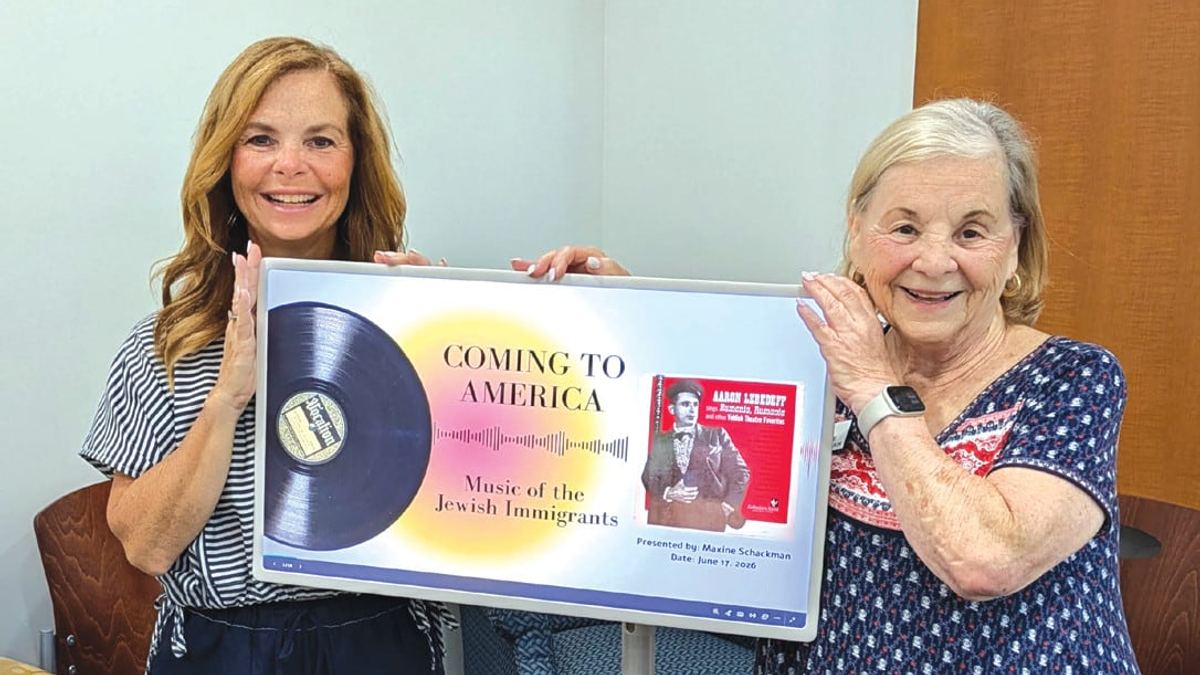
Recently, Maxine gave an interactive, musical presentation to residents of Westminster Winter Park (where she has lived for almost two years) about JSA and her work there. Her presentation, part of a Sing & Schmooze program offered by Jewish Pavilion Senior Services, was funded through a grant from the S’firot Foundation.
Buried Treasures
JSA’s story begins with a collection of donated materials that were stored on the fifth floor of FAU’s Wimberly Library in Boca Raton.
“These were extra things that the library didn’t know what to do with,” says Maxine. “An eclectic collection of Jewish memorabilia with no name, no purpose, and no curator.”
The donations included boxes of Judaica, Yizkor books, miniature wooden synagogues, and even a desk that belonged to writer Isaac Bashevis Singer. There were also recordings, mostly of cantorial music on fragile phonograph records, including the legendary Cantor Yossele Rosenblatt singing the Yom Kippur Kol Nidre prayer. Employees started organizing the materials into small exhibits, and library visitors began going upstairs to peruse the items.
“An older Jewish man took it upon himself to make a list of the recordings coming in,” says Maxine. “Records had only labels in Hebrew and Yiddish. He made a list by hand in a ledger book.”
Nathan Tinanoff, a library patron and retired IBM employee, volunteered to help turn the ledger into something more permanent and protected: a spreadsheet. He eventually took over the preservation project and set out to amass the largest collection of Jewish music, recalls Maxine.
To achieve that goal, Nathan contacted the Yiddish Book Center in Amherst, Massachusetts, which donated 4,000 phonograph records. He also reached out to private collectors, including one who had warehouses filled with recordings. Then, the FAU dean of libraries awarded a grant to the project to cover the cost of shipping the recordings to the school. Nathan began recruiting volunteers to unpack, sort, and catalog the music.
Maxine signed up to be one of those volunteers in 2002 after attending a klezmer concert with friends at the library. She had recently retired from a career as a clinical psychologist and moved from Binghamton, New York, to Boca Raton. Nathan welcomed Maxine and tasked her with placing advertisements for record donations in Jewish publications.
The Sound of (Jewish) Music
At that time, the preservation endeavor was called the Judaica Music Rescue Project. By 2005, it became the Judaica Sound Archives, with Maxine serving as assistant director and helping raise $100,000 for an FAU endowment account that would ensure the future of the collection. She spoke to Yiddish clubs and other organizations to let people know about JSA’s existence and mission. The goal was to digitize all the donated music and put it on the Internet to preserve and share the recordings. However, music is intellectual property, and most of it is copyrighted.
“Anything recorded on a record prior to 1927 was free to play and in its entirety, but anything after was copyrighted,” says Maxine, “which meant we couldn’t play anything anyone wanted to hear. Then we realized there were cantors who had recorded their music on private labels for their practice or just for their own congregation.”
Because those cantors were deceased, their families owned the copyrights and were free to ask the JSA to put the full recordings on its website. Commercially copyrighted recordings must be limited to 45-second clips online.
“They were thrilled because it was a legacy to their families and their parents’ and their grandparents’ talents,” says Maxine. “We built up a large cantorial collection that anyone could access.”
To this day, the JSA has not had to purchase any recordings because all have been donated by people who believe in its mission. In addition to cantorial music, the expansive collection includes: Yiddish theater, Ladino pieces, klezmer, children’s songs, holiday music, Broadway tunes, Borscht Belt stand- up by comedians such as Fanny Brice and Shecky Greene, love songs by Russian and Romanian immigrants, broadcasts from Israeli radio dating as far back as 1959, and tracks from Barbra Streisand, Eddie Cantor, Al Jolson, and Sophie Tucker. The oldest material dates back to 1901.
As donations of non-Jewish recordings increased, the JSA became part of the larger Recorded Sound Archives, which digitizes sound recordings of all kinds.
“Beshert – that was our motto,” says Maxine. “We felt it was just meant to be. The right people and the right place.”